
How to Search Civil Dockets
The court name on your petition, summons, notice, or order tells you where to look. Kitsap County Superior Court civil information runs through the Washington Odyssey Portal. Its statewide Case Records Search covers the civil docket. The Kitsap County Clerk keeps the underlying Superior Court file. District Court civil and small-claims cases take a different route. That route is the Kitsap District Court ePortal, which requires an account before you can search or view files.
Got the exact case number? Use it. Kitsap County has no single official civil case-number pattern across all courts. In Odyssey, format a name search as “Last, First Middle.” Pick Kitsap as the location. You can also filter common names by case type, status, file dates, or judicial officer. Business Name and Case Cross-Reference Number searches are supported too.
- Read the papers to identify Superior, District, municipal, juvenile, or tribal court.
- Open Odyssey for Superior Court or sign in to the District ePortal.
- Search with the exact case number, party name, or supported business-name field.
- Match the court, caption, filing date, case type, and status.
- Open Events or Register of Actions, then request the needed document from its clerk.
Finding Kitsap Civil Motions
When you want a civil setting rather than the whole case, try Odyssey’s Search Hearings tile. Pick Kitsap County and Civil as the hearing type. Then search by case number, party, business, attorney, bar number, judicial officer, or courtroom. A date range tightens things further. One match opens the Register of Actions directly. Several matches return a results list to browse.
| Field | Use |
|---|---|
| Party or Business | Find a civil caption when the case number is unknown. |
| Case Type and Status | Narrow similar names without inventing a local code. |
| File Date | Limit results to a known filing period. |
| Hearing Type | Select Civil, then apply court, room, judge, or date options. |
Anonymous public users of Odyssey can view public case information. Document images are another story; anonymous access does not include them. For copies and fuller document access, turn to the Kitsap County Clerk, its authorized Odyssey roles, or Washington State Digital Archives for selected records.
What a Civil Docket Shows
Think of a Kitsap County civil docket as the case’s event history. It is not a copy of every page filed. At the top, the header carries the cause number, file date, court, judicial officer, case type, status, and caption. Party sections separate the plaintiff or petitioner from the defendant or respondent. Counsel and a bar number show up when entered. The event list follows. It logs complaints, petitions, answers, service, motions, notices, orders, continuances, hearings, judgments, dismissals, and appeals.
| Case Number | The court’s identifier. Use the exact number shown on court papers, including dashes. |
|---|---|
| Parties | Plaintiff or petitioner, defendant or respondent, and counsel when shown. |
| Filings | Complaints, petitions, answers, service records, motions, notices, and orders. |
| Settings | Hearing date, time, room, judge, calendar type, counsel, and Zoom details when posted. |
| Outcome | Judgment, dismissal, or other disposition event; the signed document remains a separate record. |
Do not read a public index as a balance ledger. Report filing fees or judgment amounts only when the source record actually displays them. No official master list of Kitsap civil abbreviation meanings exists, so let the wording of the actual entry control.
Kitsap Civil Calendar Layers
Civil work in Kitsap County spreads across several calendars. The Superior Court weekly schedule covers Friday civil motions and domestic relations. It also covers probate and guardianship settings, recurring ex parte work, parentage and domestic trial calls, pro se dissolutions, civil contempt and child-support matters, and protection-order calendars. Its daily calendar lists time, judge, room, matter or calendar, counsel, and Zoom information where offered.
District Court pairs a room matrix with its account-based calendar search. Room 203 hosts civil preliminary hearings, civil motions, small claims mediation, small claims settings, name changes, and impound matters. A calendar label only tells you what is scheduled, never how the judge ruled. Check the case Events or Register of Actions for later activity. Pull the filed order when the ruling itself matters.
If a civil matter is missing: check the current daily calendar, ask Superior Court reception in Room 210 or District Court in Room 106, and verify whether the case is new, restricted, transferred, or in another court.
Types of Civil Cases on the Docket
Kitsap County Superior Court holds general jurisdiction over civil matters. Its civil docket includes general civil actions, family law, parentage, probate and guardianship, protection orders, mental-health matters, and appeals from District and municipal courts. Some categories carry special privacy rules. Just because a case appears in a search does not mean every attachment is open to any public user.
- General civil complaints, motions, trials, orders, and judgments
- Family, parentage, and domestic-relations proceedings
- Probate, guardianship, and mental-health matters
- Protection-order proceedings and related hearings
- Appeals from District Court or a municipal court
District Court handles small claims and civil cases within its limited jurisdiction, along with settings like civil motions, preliminary hearings, impounds, and some protection matters. City courts may keep city infraction, parking, or authorized protection-order material. Suquamish Tribal Court runs its own civil and civil-traffic matters under a separate jurisdiction.
Kitsap Small Claims Calendar
Small claims gets its own lane on the District Court room schedule. The published matrix sets small claims mediation on Wednesday mornings. Small claims settings fall on Tuesday afternoons. Civil preliminary hearings and civil motions also land in Room 203. Those blocks explain why a District civil case might show a mediation or preliminary hearing well before any trial event.
Keep in mind the matrix is a schedule framework, not a party-name database. To find a specific Kitsap County civil docket, sign into the District ePortal. Case Search works from the case number. Calendar Search by Name needs a last name plus an event date or range. If the online route stalls, call the District Court clerk at 360-337-7109, email districtcourt@kitsap.gov, or visit Room 106.
Settings and Hearings on Civil Dockets
Civil settings: a setting entry tells you the next court event on the docket. It might be a motion, an ex parte appearance, a preliminary hearing, mediation, trial call, or a protection-order hearing. The posted row usually lists the date, time, judge or commissioner, courtroom, counsel, and how to join remotely. When the clerk enters a notice of setting, or later a continuance or reset, that activity should show up in the case record too.
Kitsap County Superior Court calls its daily docket courtesy information. It is current when posted but subject to change. Hallway screens display each cause number, party name, judicial officer, and courtroom for the day. If a setting has changed or gone missing, verify it with the clerk. Find My Court Date covers District and municipal cases. Superior, family, juvenile, and appellate dates come from each court's own source.
Remote access depends on the calendar. Civil motions, unlawful detainer matters, probate or guardianship hearings, domestic proceedings, and protection hearings each carry their own rules for Zoom or in person. A link alone is not permission to appear remotely. Follow the current calendar and the judicial officer's instructions.
Kitsap Docket Versus Judgment
Three civil records answer three different questions. The docket, also called the Register of Actions, shows the order of events. An order captures a judge's direction on one issue. A judgment states a final or enforceable result once one has been entered. Seeing "judgment" or "order" in the docket only proves an event was recorded. The signed filing supplies the controlling text.
Take the case number you found in Odyssey or statewide search to locate selected Superior Court documents in Digital Archives, or to make a focused Clerk request. The Kitsap County Clerk handles copy requests in four forms: plain, certified, authenticated, and exemplified. District Court keeps its own case files. City-court material sits with a municipal clerk. The county public-records office replaces none of them.
Public Access to Civil Dockets
Access to court records in Washington runs through General Rule 31. The rule presumes access while weighing privacy and the burden on courts. The Kitsap County public-records page draws a clear line. It separates court files from agency records under the Washington Public Records Act, chapter 42.56 RCW. Judicial administrative records follow GR 31.1. Case documents go to the proper clerk.
GR 22 adds special limits for family, protection-order, guardianship, and therapeutic records. It shields personal identifiers. Those include Social Security numbers, driver's-license numbers, account numbers, phone numbers, and a child's birth date. Sealed files cannot be viewed or copied. Still, a docket may reveal that sealed material exists. The court can restrict that fact too. Juvenile dependencies and adoptions stay closed to Room 202 public viewing.
Access rule: A public case name or docket entry does not make every attachment public. Ask the clerk about GR 31, GR 22, redaction, sealing, and any court order that controls access.
Kitsap Civil Access Channels
For Superior Court, several routes work. Search Odyssey or the statewide index. Inspect the posted daily and weekly calendars. Call the Kitsap County Clerk at 360-337-7164. You can view eligible files in Room 202. Or send a sufficiently specific copy request by mail, email, or in person. Selected documents can be purchased from Washington State Digital Archives. Anyone may observe in the courthouse. Remote observation depends on the calendar and is never guaranteed.
District Court offers the ePortal, the room calendar, or the clerk counter in Room 106, 360-337-7109, or districtcourt@kitsap.gov. City files belong to a municipal clerk. Washington Courts Case Records Search can help locate municipal, District, Superior, or appellate cases. But it warns of missing or inaccurate status, docket, judgment, and link data. Confirm any consequential civil result with the court that owns the original record.
A blank search is rarely the final word. Check the spelling, the court level, the exact number, and the file date. A recent entry may not appear in the statewide index yet. The matter could be sealed, restricted, archived, transferred, appealed, municipal, juvenile, or tribal. Run through that routing list before assuming no Kitsap County civil docket exists.
Kitsap County Civil Docket Reports
Washington Courts publishes official monthly and annual caseload reports. They cover Superior Courts and courts of limited jurisdiction. The tables give useful context on Kitsap County civil work. They cannot replace a party-name search or an individual Register of Actions, though. The Washington Courts caseload archive posts those reports.
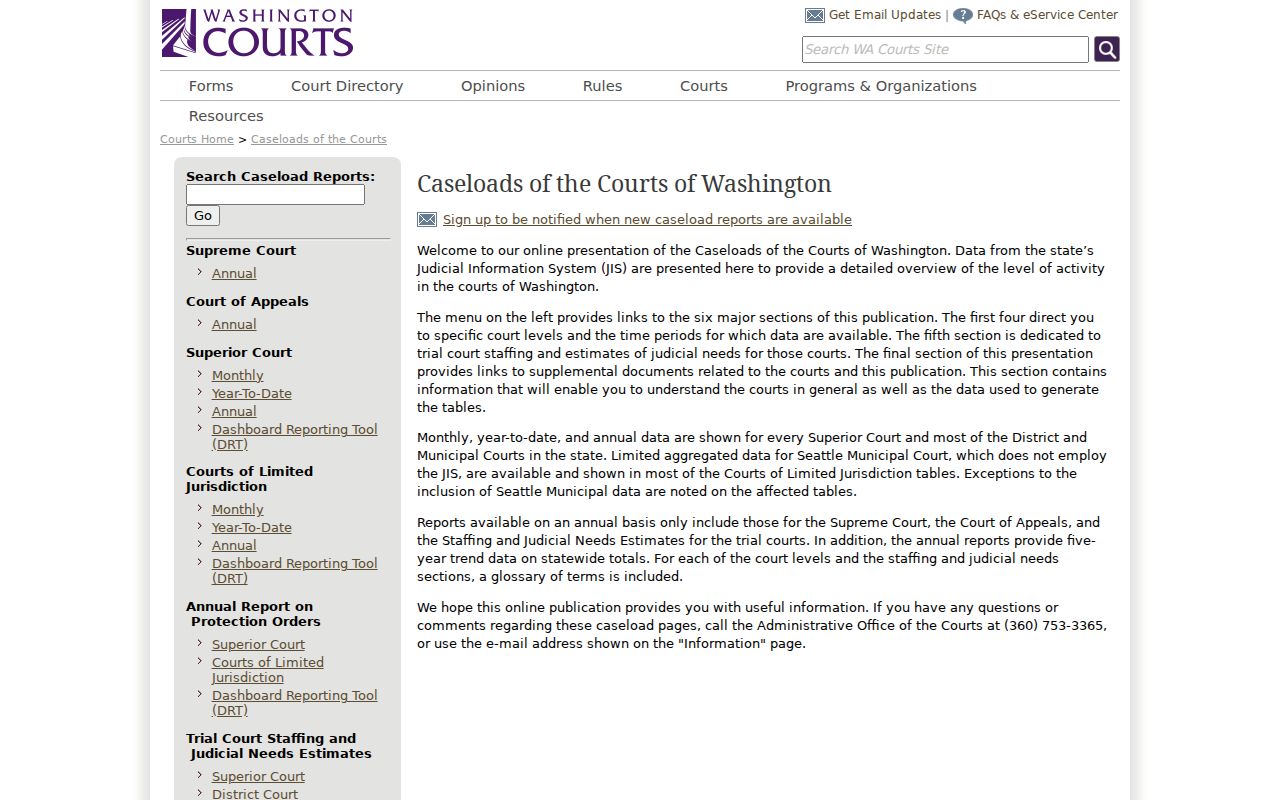
The report navigation keeps aggregate court statistics separate from the case-specific tools used to find a filing or hearing. Each serves a different purpose. Statistics describe volume; search tools locate one Kitsap County civil docket.
Kitsap County Civil Appeal Dockets
A civil matter from District or municipal court can later reach Superior Court on appeal. The appeal may carry a new cause number and a fresh docket. The Kitsap County Clerk becomes a different custodian.
Keep both case numbers. The limited-jurisdiction file explains the first proceedings. The Superior Court record tracks appeal filings, settings, and disposition.
Kitsap County Civil Docket Restrictions
Family, protection-order, guardianship, mental-health, and juvenile-related matters get closer access review. GR 22 can hide personal identifiers and source documents. A public caption or event can still stay visible. Redacted is not sealed. A missing portal image does not prove the whole file is closed. Ask the clerk about the specific document and your access role. That focused question beats a blank screen every time.