
Traffic Court Records in Kitsap County
County traffic and non-traffic infractions usually land in Kitsap County District Court. Tickets written inside city limits go elsewhere. The options are Bainbridge Island, Bremerton, Port Orchard, or Poulsbo Municipal Court. Each court keeps its own file. Suquamish Tribal Court stands apart as a separate sovereign forum. Contact it directly about its civil-traffic matters.
A traffic court record here can show the notice, the response you chose, hearings, the decision, judgment, payment, and collections. District cases belong to the District ePortal and the District clerk. City cases stay with city clerks. A statewide name search may still turn them up. Check the court name printed on your notice. Do that before picking a portal, pay service, or mailing address.
Kitsap Traffic Ticket Response Deadlines
The Kitsap District Court infraction instructions draw a line between officer-issued tickets and mailed notices. Hand a ticket to you by an officer, and you get 30 days to respond. A mailed ticket allows 33 days from the mailing date. The current response form also points to 33 days. When those statements clash, trust the due date printed on your actual notice and form.
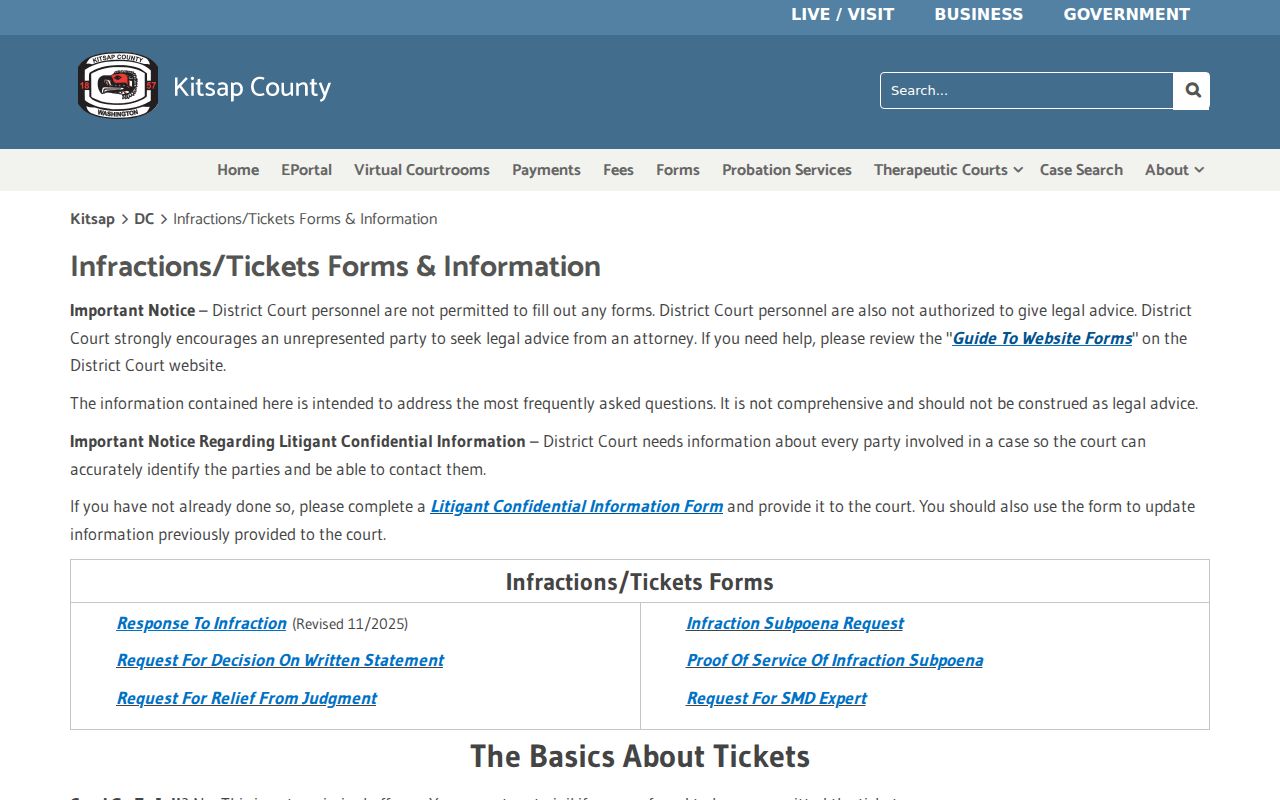
The official page lays out both the local choices and the deadline each one follows. An officer-issued ticket gets completed on the back. Pick an option, sign it, and add a current mailing address. A mailed ticket uses forms instead. You will need the Response to Infraction form plus the Litigant Confidential Information form. However you send it, the response must be postmarked, emailed, or eFiled by midnight on the due date.
How to Look Up a Traffic Ticket
Begin with the issuing court and the exact citation or case number. The District Court ePortal searches by case number. You must log in first. No number handy? Its Calendar Search by Name takes a last name plus an event date or range. Find My Court Date pulls real-time calendar data. It covers District and municipal courts, searchable by court name and party name.
- Read the notice for the court, due date, case number, and citation number.
- For District Court, sign in to ePortal and search the exact case number from the ticket.
- For District or municipal dates, select the exact court in Find My Court Date and enter the name from court papers.
- If no result appears, call or visit the issuing clerk; District Court is 360-337-7109 in Room 106.
- Confirm the response deadline, setting, status, and amount with that court before acting.
District responses have other routes too. Bring them to Room 106, mail them to 614 Division Street, MS-25, Port Orchard, WA 98366, or email districtcourt@kitsap.gov. Statewide Case Records can help spot a case. Still, the court of record owns the full, current traffic file.
Kitsap Traffic Search Fields
The date, case, and payment tools in Kitsap County traffic court records each ask for different fields. Don't push a citation number into Odyssey. Its Washington guide marks citation-number search unavailable, and Odyssey skips courts of limited jurisdiction anyway.
| Tool | Fields | Use |
|---|---|---|
| Find My Court Date | Court Name, First Name, Last Name, reCAPTCHA | District or municipal date and case activity |
| District ePortal case search | Case Number | District file after account login |
| District calendar by name | Event Date or range, required Last Name | Setting when number is unknown |
| nCourt | Ticket, citation, or case number; penalty if known | District payment |
Type the number exactly as court papers print it. The official sources publish no single safe universal format. So no guessed sequence should ever stand in for the real case number printed on the citation.
Finding Your Traffic Court Date
The appearance date on a ticket is only a starting point. Confirm it against current Kitsap County traffic court records. A hearing can be set, reset, continued, or canceled. Find My Court Date draws on live data for District and municipal courts. The District calendar search finds a setting by last name and date range. Nothing there? Call the clerk.
| Citation or Case Number | Use the exact number on court papers; format is not specified in the official guide. |
|---|---|
| Court | Kitsap District or the named municipal court that issued the notice. |
| Date and Time | Current appearance, mitigation, contested, or other hearing setting. |
| Room or Access | District room assignment or current court instructions for appearance. |
| Status | Pending response, hearing, committed finding, payment, or collection activity where shown. |
For District Court, the room matrix puts contested and mitigation infraction calendars in Room 203 on set days, with calendar caps. It is not a person-name database. Confirm the live case record or ask the clerk before treating the matrix as proof your case is on the docket.
Kitsap County's Six Ticket Responses
Kitsap District Court offers six response choices. Each one builds a different traffic court record. Pay in full, and the record shows a committed judgment. A payment plan admits responsibility while asking about installments. Contested hearings challenge the infraction outright. Mitigation admits it but asks the judge to weigh circumstances. A deferred finding hinges on eligibility and compliance. A written statement lets the judge decide on the papers.
- Contested hearing
- The prosecution must prove the infraction by a preponderance, and a witness can be subpoenaed.
- Mitigation hearing
- The person admits the infraction but may seek a lower monetary penalty based on the facts presented.
- Deferred finding
- A judge may impose conditions for up to one year, with state limits on frequency and eligibility.
- Written statement
- The judge decides from the filed statement and supporting copies; Kitsap says that decision cannot be appealed.
Deferred findings get tricky with commercial-license and commercial-vehicle exclusions. Eligibility belongs to the court, not to an online pay screen. And when local instructions call for copies, never mail original proof with a written statement.
Paying or Contesting a Ticket
Paying and contesting don't produce the same Kitsap County traffic court record. Payment counts as a response and ends in a committed finding. Contesting requests a hearing and requires you to appear. Mitigation splits the difference. It accepts the infraction while asking the court to weigh the facts and the penalty.
| Paying the Ticket | Contesting the Ticket |
|---|---|
| Judgment enters as committed | Not-guilty response produces a contested setting |
| Pay online, by phone, in person, or by approved mail method | Return the signed response through an accepted court channel |
| Payment plan may route to CPMS when longer than 60 days | Appear and present the challenge; subpoenas may be available |
Missed response or hearing: A judge may find the ticket committed, increase the penalty, report a traffic case to DOL, and trigger suspension action.
A missing calendar row proves nothing about dismissal. Call the issuing court right away. The Kitsap court calendar adds context on resets, but only the clerk's current record confirms the ticket setting.
Kitsap nCourt Payment Route
Traffic fines in Kitsap County can be paid online. Phone payments work too, through the Kitsap District Court nCourt page. The service asks for your ticket, citation, or case number. It also wants the penalty amount if you know it. Missing one of those? Call District Court at 360-337-7109. One wrinkle exists: a debt already sent to collection goes to Dynamic Collectors, not nCourt.
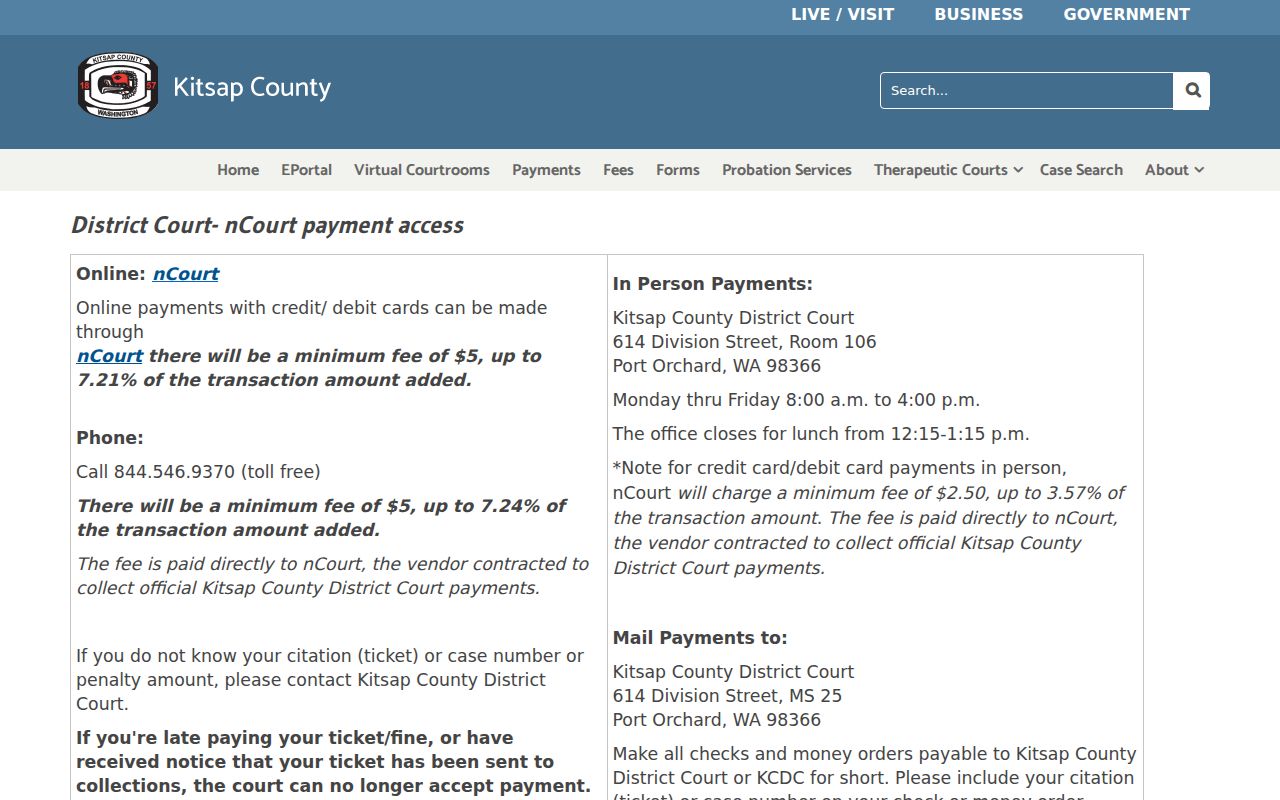
The official payment page makes one thing plain: nCourt moves money, and that is all. It processes a District Court payment. Yet it settles no disputed citation and substitutes for nothing in the clerk's docket. Before sending funds, check the case number and confirm the balance. Know what response your payment counts as. Cash by mail is never the way.
Court Traffic Record vs Driver Record
Two different records exist here, held by two different offices. The Kitsap County traffic court record sits with the issuing court and its clerk. The Washington Department of Licensing keeps the driver record, a wholly separate file. When a court commits a traffic result, reporting rules can carry that result to DOL. Still, the two files never merge. A court portal will never work as a DOL search.
| Court Traffic Record | Driver Record | |
|---|---|---|
| Kept by | Kitsap District or issuing municipal court | Washington Department of Licensing |
| Shows | Citation, response, hearing, decision, judgment, payment or collection events | Licensing-side reports and status maintained by DOL |
| Get it from | Court portal, phone, counter, mail, email, or clerk request | DOL's own record-request channel |
So an empty court search says nothing about your license file. A DOL record, likewise, is not the court case. The distinction matters only because requests so often land at the wrong office.
Kitsap Deferred Finding Record
A deferred finding is not a dismissal on day one. Kitsap's own form spells out the terms. Conditions run up to one year. An administrative fee applies, and no new qualifying infraction is allowed during the deferral. State law caps how often a moving and nonmoving infraction can be deferred. It also rules some cases out entirely. Eligibility rests with the judge. Meet every condition, though, and the court can dismiss the infraction once the period ends. Fail one, and the docket may show a committed finding. The court reports that finding to DOL. Hold onto the court order and watch the deadline. Then confirm the final docket entry with the clerk. Never assume that getting into the program closed the case.
Fees and Copies
Penalties differ by citation, so the live case and the court's current schedule govern. A payment channel can add its own convenience fee. District Court publishes fee groups for civil, administrative, infraction, and criminal matters. Each group is tied to statutory authority. Pull out your traffic case number and confirm which charge fits. The official Kitsap District Court fee schedule is the right place to check a current charge.
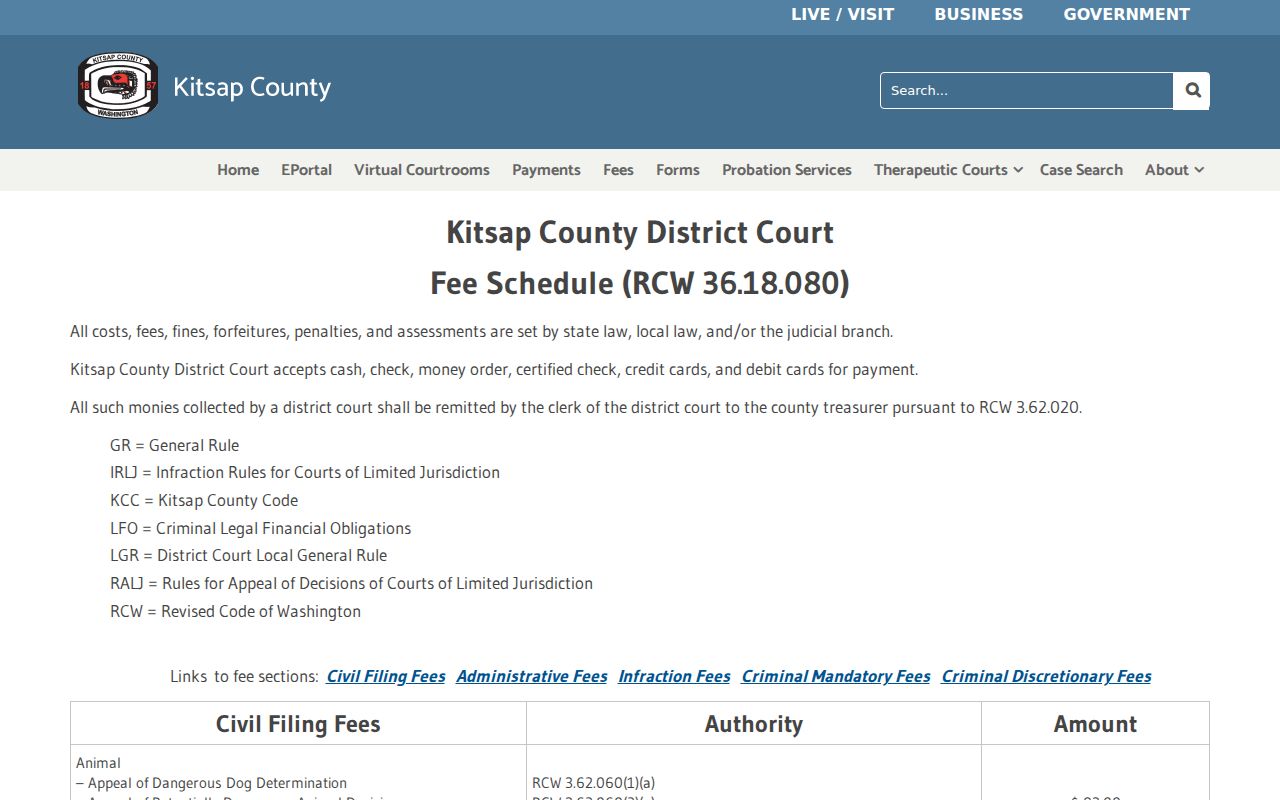
The fee tables show why talk of "the traffic fee" misleads. Every transaction must be matched to its own table and authority. Want a copy of the traffic file instead? Ask the issuing clerk about page cost, certification, and delivery. Superior Court copy pricing never applies to a District or city file. Each court sets its own numbers.
Kitsap Traffic Payment Fees
District nCourt tacks on a vendor charge for online or phone payments. That charge runs at least $5. Online charges can hit 7.21 percent; phone charges, 7.24 percent. Pay by card in person and you face a minimum $2.50 charge. That in-person charge can reach 3.57 percent. None of that is the citation penalty itself, only the cost of the service. Late or collection accounts may go to Dynamic Collectors at 800-464-3457. A District payment plan running past 60 days may shift to Court Payment Management Services at 360-748-4784 or 877-748-4936. City courts run their own payment systems with their own charges. Confirm the right court first. Paying one clerk never resolves a case held by another. Remember that payment can record a committed judgment. Read the response you choose and verify its docket effect before sending money.