
How to Search Criminal Dockets
Begin with whatever court is named on your citation, notice, or charging papers. Felony cases belong to Kitsap County Superior Court. The Kitsap County Clerk keeps those records. You can search public case information through the Washington Odyssey Portal or the statewide Case Records Search. County misdemeanors and gross misdemeanors go to Kitsap County District Court. That court runs its own District Court ePortal. A charge filed inside one of the four incorporated cities might stay with that municipal court instead.
Before you type anything, gather the full party name and the exact case number. There is no single official Kitsap criminal number format. Copy every dash and character exactly as it appears on court papers. A name match is just a lead. Check the court, the file date, the case type, and the party role. Only then trust the docket entry you have found.
- Identify Superior, District, municipal, juvenile, or tribal court from the papers.
- Use Odyssey for Superior Court or register for the District ePortal.
- Search by exact case number, or use the supported party-name fields.
- Open the case and review Events, Hearings, Disposition Events, and Register of Actions.
- Confirm the result or obtain a filed order from the clerk that keeps the case.
Kitsap Criminal Search Split
No single search reaches every Kitsap County criminal docket at the same depth. Odyssey covers participating Superior Courts. Kitsap County Superior Court is among them. Courts of limited jurisdiction, though, are left out of that portal. Anonymous users can read public case information there. Document images, though, need a clerk-authorized access role. Advanced search fields cover party or business name, case number, attorney, judicial officer, case type, status, file dates, and Kitsap as the location. The Search Hearings option adds a Criminal hearing type plus filters for courtroom or date.
The District ePortal works only with an account. Its official guide runs Case Search off the case number. Calendar Search by Name needs a last name and can take an event date. Attorneys and officers can pull calendars with a bar or badge number. For municipal cases, try Washington Courts Case Records Search or Find My Court Date. The city clerk still keeps the complete file, though. Suquamish Tribal Court sits outside all of this. It is a separate forum that state portals never search.
What a Criminal Docket Shows
A Kitsap County criminal docket gives you the timeline, not the whole paper file. Odyssey labels the event list the Register of Actions. The statewide system may call the same entries Case Activities. Read the header first. Then work through parties, events, hearings, and any disposition entry. A calendar label like “criminal in custody” only describes the type of setting. That proves no guilt, no dismissal, no outcome.
| Case Number | The court-assigned identifier. Enter the exact number from court papers, including dashes. |
|---|---|
| Parties and Charge | The prosecuting authority, defendant role, charge description, and classification when exposed. |
| Events | Dated filings, arraignment, pleas, motions, continuances, trials, orders, and appeals. |
| Hearings | Date, time, judge, room, setting type, custody label, and Zoom information when posted. |
| Disposition | A disposition event and date. The signed order or judgment is a separate document. |
The county publishes no countywide list of criminal disposition codes. Plain terms beat guessing at an abbreviation. Trust financial or bond details only when the court record itself displays them.
Kitsap Criminal Calendar Labels
Local calendar names help you find the right row fast. The Superior Court weekly schedule runs criminal in-custody, criminal trial call, criminal out-of-custody, criminal after-sentencing, and criminal arraignment. It also posts Adult Drug Court, Veterans Court, and trial-setting calendars. District Court posts room-based calendars instead. Those cover arraignments, motions to revoke, bench-warrant quashes, in-custody video dispositions, and trials. Behavioral Health Court, THRIVE, and felony diversion also appear.
Trial Call is a readiness or scheduling calendar, not the trial itself. BHC means Behavioral Health Court, and THRIVE means Teaching, Healing, Resilience, Independence, Voice, Empowerment Court. When PDA/DP appears, it signals pretrial or deferred-prosecution compliance matters, so verify the event in the case record.
Check the Superior Court Daily Calendar for posted settings, then confirm any changes with the Clerk. That page is courtesy information and can shift. District Court relies on its ePortal and room calendar. If a row is missing or moved, that alone does not mean the criminal charge ended.
Stages on a Criminal Docket
The first entry you see may be a charging filing, followed by arraignment. From there, the event history builds up. Pretrial hearings, motions, continuances, and trial settings stack into it. A plea or trial can produce a disposition event. That may bring a sentencing entry and a signed order. Not every case walks that line. Deferred prosecution, diversion, or a treatment program can route it elsewhere. Official Kitsap forms include trial confirmation and unconfirmation notices, proposed pleas, and continuance orders. You may also see jury or trial-time waivers plus BHC, THRIVE, and felony-diversion packets.
Docket flow: Charge Filed › Arraignment › Pretrial Settings › Plea or Trial › Disposition › Sentencing
Those form names make useful search clues. They are not disposition codes. A filing entry tells you a document hit the file, not what the judge decided. Read the event sequence first, then request the filed judgment or order whenever the exact result matters.
Kitsap Therapeutic Criminal Dockets
Kitsap County runs named therapeutic settings alongside its conventional criminal calendars. The county’s treatment-courts page describes Adult Drug Court. District Court materials cover Behavioral Health Court and THRIVE. These names explain a docket pattern. Instead of a straight run from arraignment to trial, you may see recurring review or compliance settings. The program page shows what each setting means within the county’s court system.
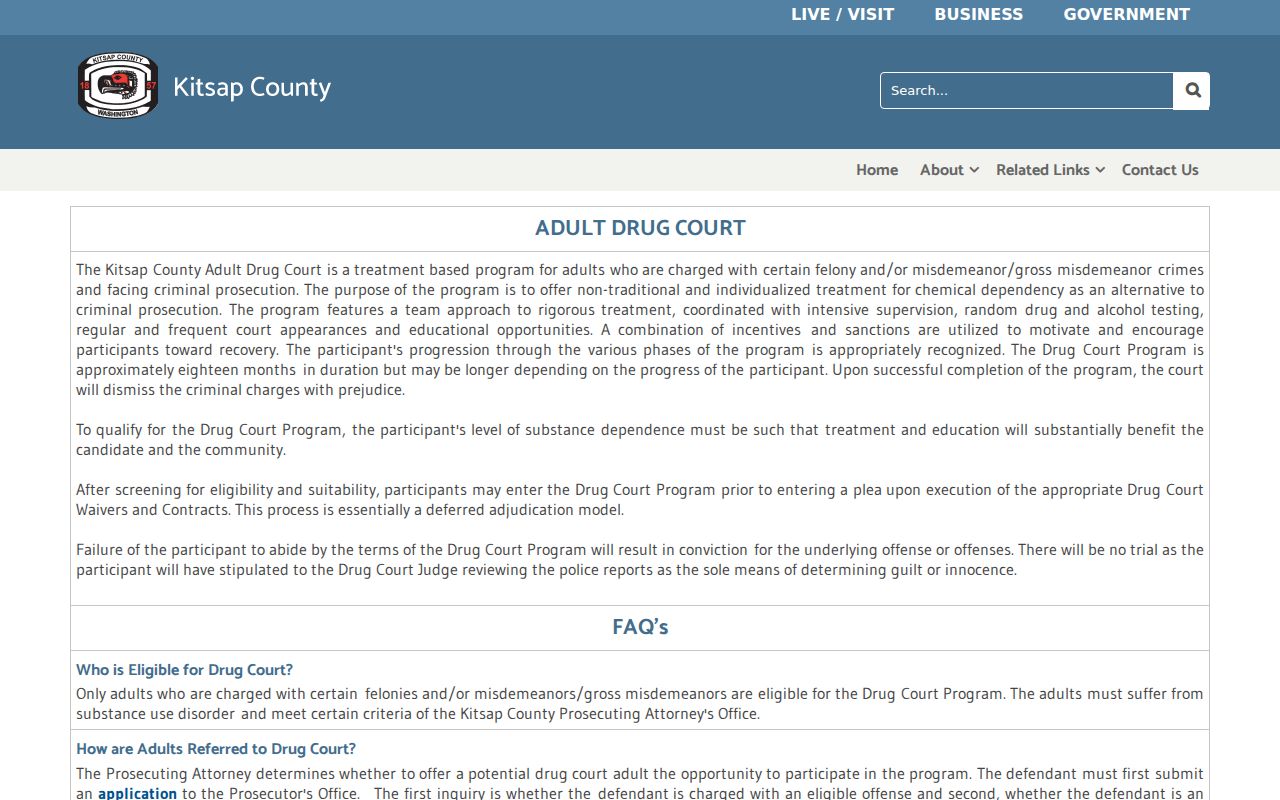
The official page connects each label to a real Kitsap County court process. It does not show that any named person is eligible, enrolled, or finished with a program.
Which Court Holds Criminal Dockets
Kitsap County Superior Court is where felonies land. Misdemeanors and criminal traffic go to District Court. The Kitsap County Clerk preserves the Superior Court filings, hearing minutes, and exhibits. That office handles copies. District Court runs a separate clerk and its own ePortal. Each city runs its own municipal court too. Bainbridge Island, Bremerton, Port Orchard, and Poulsbo each hold misdemeanor, gross-misdemeanor, and criminal-traffic files. Those files come from inside their city limits. Juvenile offender cases move through the Superior Court and Youth Service Center. State law restricts what juvenile information can be shared. An appeal from District or municipal court opens a new Superior Court docket. It gets a different cause number. Suquamish Tribal Court handles tribal criminal matters within its jurisdiction. So follow the named court. Never assume the Kitsap County Clerk holds every criminal file.
Kitsap Clerk Access Channels
Start with a call for Superior Court records. The Kitsap County Clerk answers 360-337-7164. Public files can be viewed in Room 202. Second-floor screens and the daily docket show current settings, and Room 210 is the fallback when a matter is missing. District Court keeps its records in Room 106. That office answers 360-337-7109 or districtcourt@kitsap.gov. Any copy request, by mail, email, or in person, must identify the case well enough for staff to find it. Washington Courts Case Records Search serves as a statewide index, but the official service warns that dockets, judgments, links, and status can be missing or inaccurate. Selected Superior documents may be bought through Washington State Digital Archives. Posted calendars add another way to follow a setting. Some proceedings even allow Zoom. Remote viewing is not guaranteed, and some matters require an appearance in person.
Criminal discovery is different. Police reports and prosecutor discovery are not court-file copy requests. The Kitsap Prosecutor routes criminal and traffic discovery to its Criminal Division at 360-337-7174 or KCPA@kitsap.gov.
Public Access and Sealed Criminal Dockets
Access to court records in Washington runs through General Rule 31. That rule balances openness against privacy and court burden. Kitsap County treats ordinary case files as governed by court rules and common law. The Public Records Act does not apply. That Act process belongs to county agency records instead. GR 31.1 covers judicial administrative records rather than case filings. Sealed documents and sealed cases stay closed. The public cannot view or copy them. An entry noting that sealed material exists may remain, unless the existence itself is restricted. Anonymous Odyssey users cannot see restricted cases or images. Juvenile records get special handling under RCW 13.50.050, and RCW 13.50.260 governs juvenile sealing. A blank search can mean the wrong court, a recent filing, a spelling mismatch, or a legal access limit.
Key rules: GR 31 governs Washington court records. RCW 13.50.050 sets juvenile-record access. RCW 13.50.260 addresses juvenile sealing.
Verify a Kitsap Criminal Result
A docket entry can locate a hearing. It does not prove the result. Check the court name, case number, file date, party role, and status. Compare Events, Disposition Events, and the Register of Actions. Calendars change, so call the clerk when a setting is urgent. For a definitive outcome, get the filed judgment or order from the court of record. If no result appears, try the exact name from the papers. Use the case number. Remove any narrow date filter. Consider whether the case sits in District Court or a municipal court. It may not be in Superior Court at all. Juvenile, sealed, restricted, appealed, and tribal routing can also hide a result. These steps close most gaps. They do so without treating an index result as the official Kitsap County criminal record.
Kitsap County Criminal Docket Forms
Terse event names on a Kitsap County docket often trace back to official forms. Trial confirmation and unconfirmation notices, proposed plea forms, continuance orders, deferred-prosecution petitions, and trial-time waivers can each create a dated entry. Treatment and diversion packets generate repeat review settings. A form title is a clue. It is not a ruling. Match the form's date to later hearing and disposition events, and ask the proper clerk for the filed order when the event text leaves the result unclear.
Kitsap County Municipal Criminal Dockets
A city-limit misdemeanor may stay in Bainbridge Island, Bremerton, Port Orchard, or Poulsbo Municipal Court. A statewide search might locate it. The city clerk still owns the complete file. Check the charging court before assuming a missing District result means no case exists. An appeal later can open a new Superior Court docket. It comes with a new cause number. Keep both numbers, since each documents a different stage of the case.
Kitsap County Criminal Docket Gaps
A blank result on a Kitsap County criminal docket search rarely means the case is gone. Usually the cause is small. It might be a name spelled differently, a filing too recent to index, or a date filter set too tight. The case could also sit in another court entirely. Some records never show up at all. They are juvenile, sealed, restricted, archived, tribal, or moved up on appeal. When a Kitsap County docket search comes back empty, go back to the exact case number and the court name. Then call the clerk or city court that holds the file. The current court record always beats an old index entry.